
your knowledge, accessible
Making Meaning Machine-Readable
Triples, TBox & ABox
Knowledge Graphs for AECO — a course for domain experts
Where we are going today
- Explain what "machine-readable" actually means, as opposed to a human-readable PDF or a BIM model file.
- Break a plain-language statement into a Subject–Predicate–Object triple.
- Tell TBox (what types of things may exist) apart from ABox (what actually exists).
- Explain why one fact can have several contradictory versions — and why that's a feature, not a bug.
Yesterday
Every manual connection you counted in "Graph your Monday" is an edge that exists — but only in your head.
Today: what does it take to write one of those edges down so precisely that a computer can act on it?
Human-readable is not machine-readable
A PDF, a scanned drawing, a specification chapter
…all require a person to read them and interpret them before any conclusion can be drawn.
A BIM model is closer — but the meaning is still locked inside a proprietary file
You need the right software, the right version, and someone who knows where to click.
Machine-readable means the fact is stated explicitly enough that a computer — or an AI — can act on it without a human translator in the loop
The smallest unit of meaning
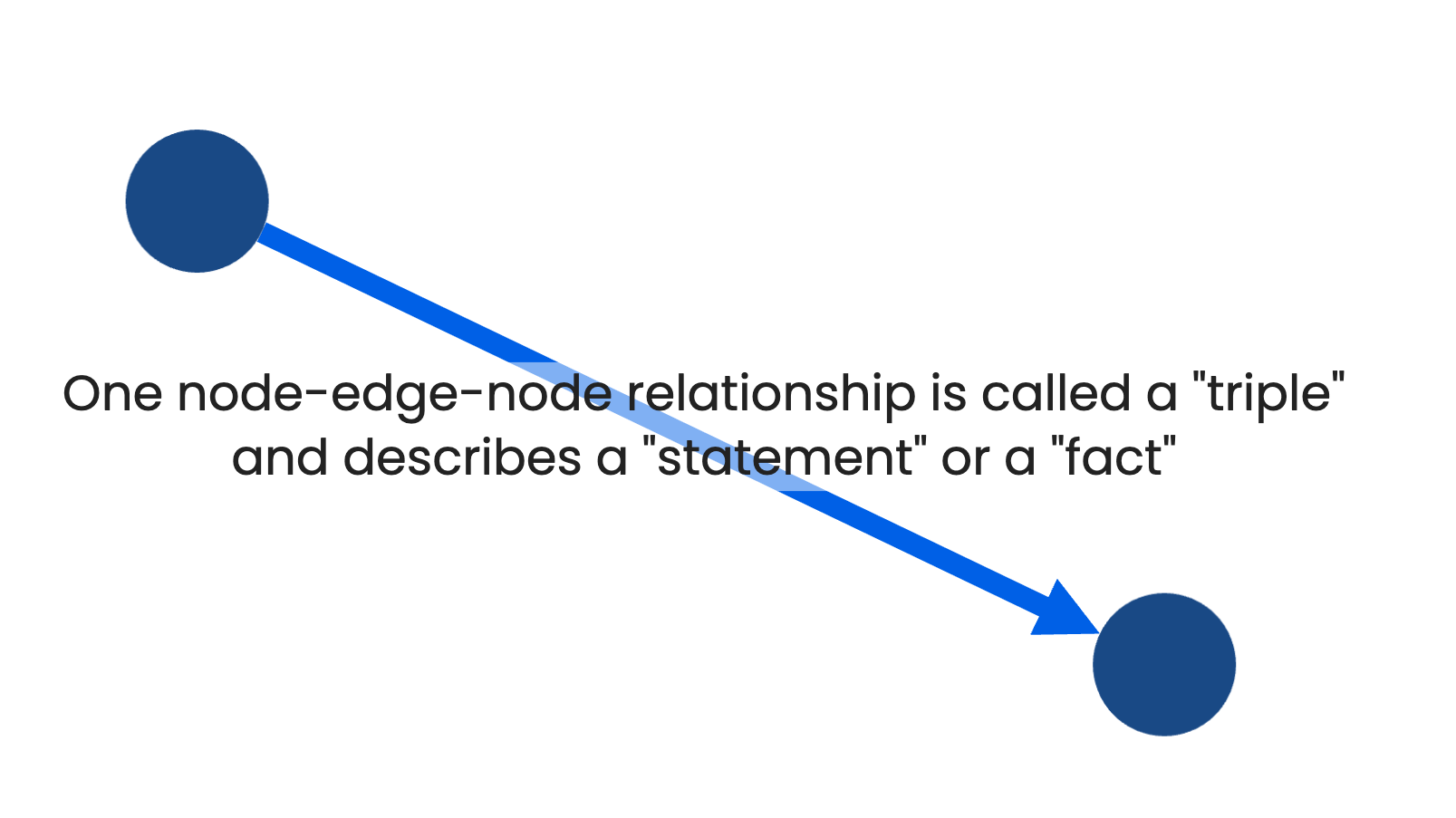
One node-edge-node relationship is called a "triple" and describes a "statement" or a "fact"
A triple consists of a Subject, a predicate and an Object
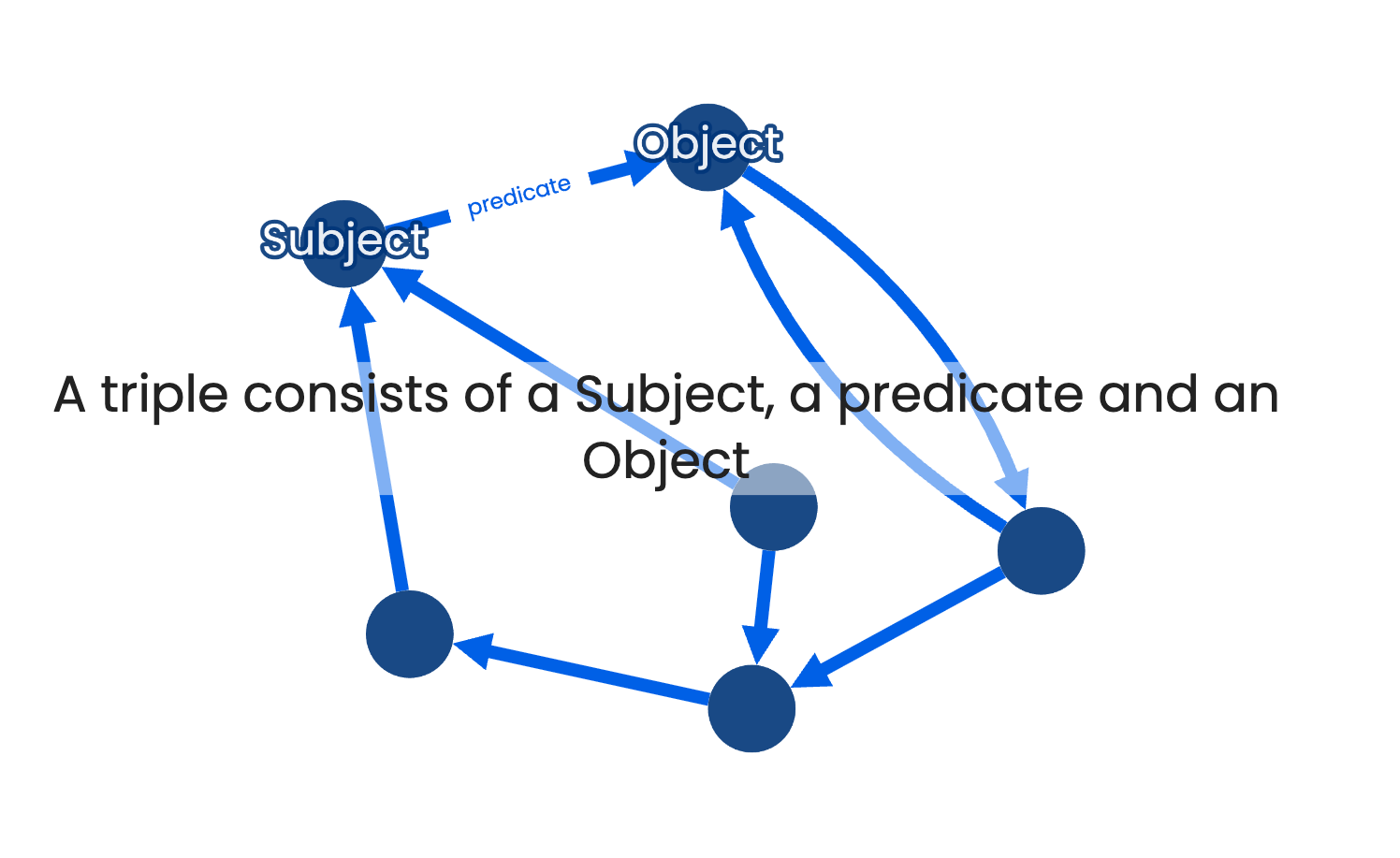
It reads like the simplest possible sentence
A thing · a relationship · another thing.
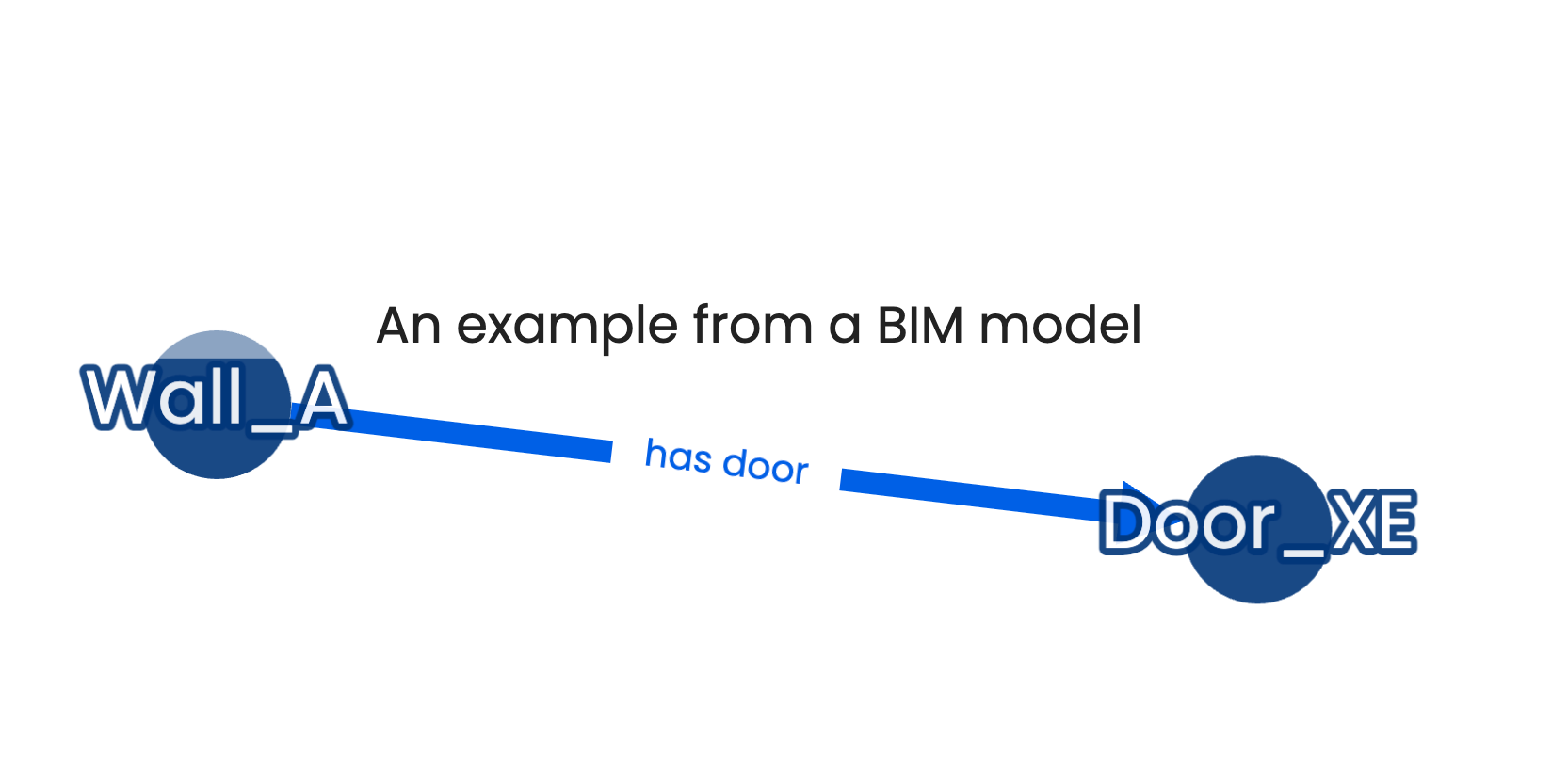
An example from a BIM model
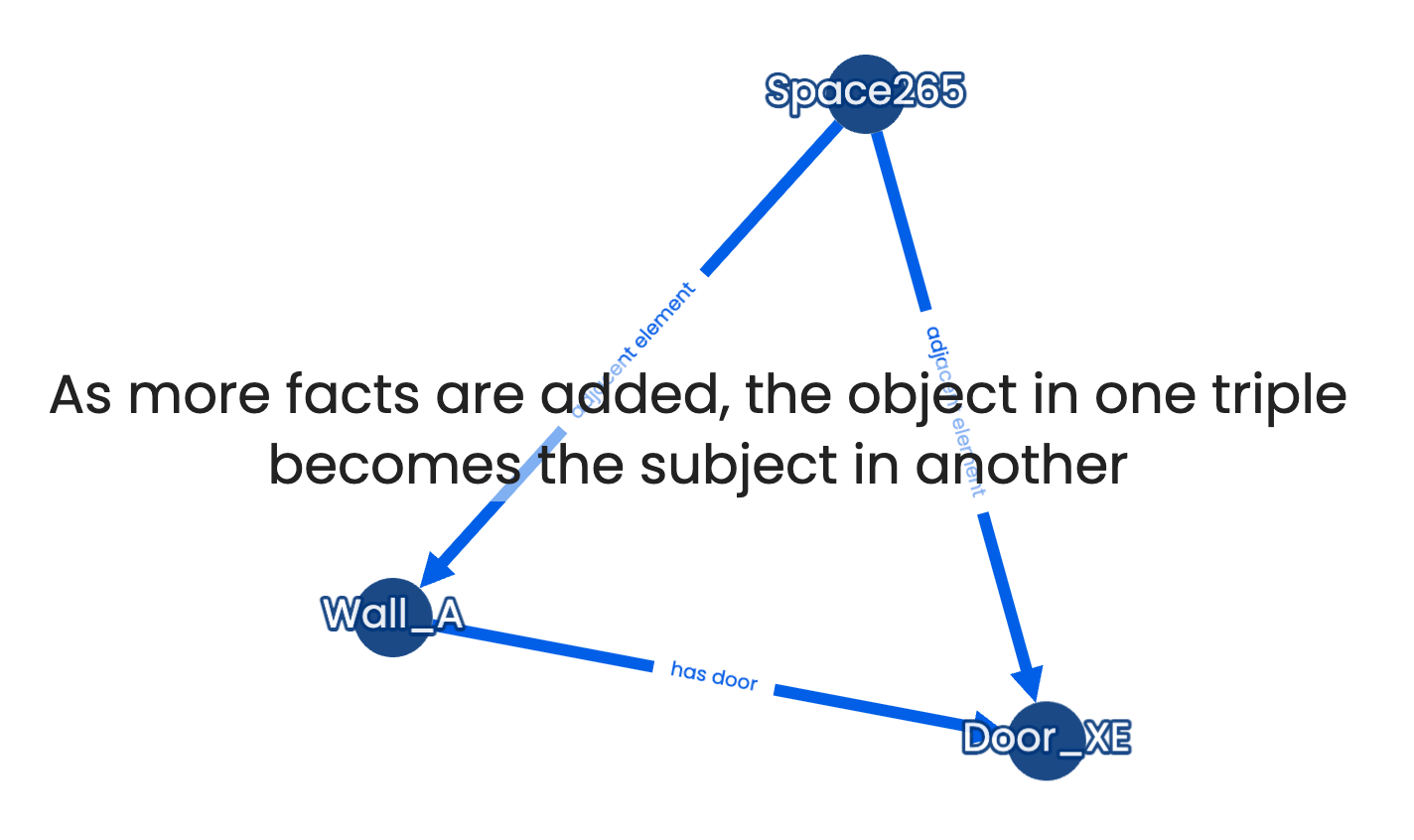
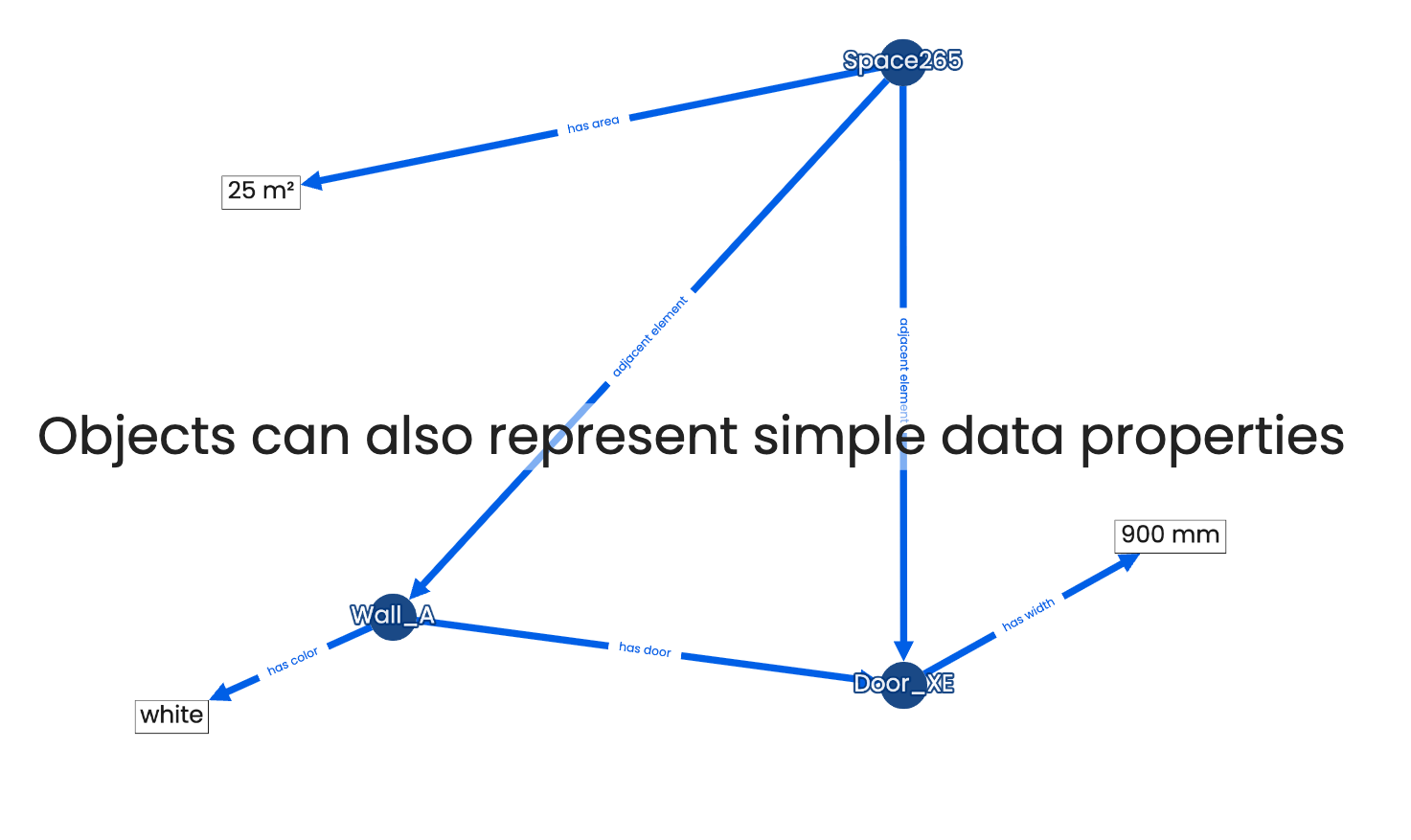
As more facts are added, the object in one triple becomes the subject in another
Objects can also represent simple data properties
Nobody writes triples one at a time
They accumulate. A wall's door, the door's material, the material's supplier — each fact clicks onto the last, and a network builds itself.
Two kinds of statement
We distinguish between the assertion layer (ABox) and the terminology layer (TBox)
"A bot:Space can be inside a
bot:Storey."
Defines what is possible — not what exists yet.
"Room 201 is inside the 2nd Floor."
States what is actually true, for a specific building, right now.
Why separate them?
- The building changes constantly — the ABox churns
- What kinds of things exist changes slowly — the TBox is stable
- Keeping them apart is what lets the graph stay useful as reality moves underneath it
Multiple realities
The web follows the AAA principle
Anyone can say Anything about Anything
It is up to you as a reflective individual to form your own opinion
This can be good or bad, but most importantly it lets us deal with the fact that reality is complex
Construction projects are also complex and there will exist more realities simultaniously
Drawing conclusions requires gathering information from multiple sources and always includes a multitude of assumptions
"Would the carbon footprint be reduced if we switch to a wooden structure?"
- It depends on how you calculate it!
Furthermore, the reality rapidly changes during the design stages making it hard to gather the current state of truth
"Is the door red or orange?"
- It depends on when you ask!
Over the years we gather so much information that multiple realities will inevitably exist
"Was this wall removed?"
- It depends on which document you look at!
Whose version is true?
"Was this wall load-bearing?" — depends on which revision of the structural drawing you trust, and when.
"Is the setback 3 metres or 4?" — depends on whether you read the original permit or the as-built survey.
"Was this filter replaced last quarter?" — depends on whether you trust the CMMS log or the technician's paper checklist.
Let's take a look at how we deal with inconsistencies
Let's see how an LLM would interpret it
Let's imagine that we had access to some provenence data about each statement
Full prompt for you to try
Context is important!
Trust needs context, not censorship
Notice what we did not do: pick a winner and delete the loser.
- Keep all competing statements
- Attach who said it, when, from what source, how confidently
- Let the person — or the AI — weigh the evidence
The richer the input, the richer the output
True of human judgement and of AI alike.
Advanced — optional
How the door demo actually works under the hood
With RDF* (RDF star) it is posible to make a statement about another statement
Let's imagine we would like to describe some provenance about this fact
In RDF* it would look like this
In Turtle* syntax it would look like this
Exercise: "Triple it"
Pen and paper.
In small groups, 20 minutes.
- Take the handout — a short paragraph from a real specification or room data sheet.
- Rewrite three to five sentences as Subject–Predicate–Object triples, one per index card.
- Lay the cards out and connect them with string wherever an object in one card is the subject of another.
Now sort your cards into two piles
"This describes a type of thing."
"This describes a specific thing."
Which pile was bigger? Which was harder to agree on?
Key takeaway
"A fact isn't just data — it's a claim, made by someone, at some point in time, with some level of confidence. Machine-readable means explicit enough that a computer can tell the difference."
Tomorrow
We have facts. Now: why is asking questions of a graph fundamentally different from asking them of a database — and why does that mean nobody in this room needs to learn a query language?
Day 3 — Graphs vs. relational databases