
your knowledge, accessible
The Knowledge Graph as Integration Layer
Bringing it all together
Knowledge Graphs for AECO — a course for domain experts
Where we are going today
- Articulate why a knowledge graph is a non-intrusive integration layer, not a replacement for existing systems.
- Explain how provenance lets an organization keep conflicting versions of the truth and still reason about which to trust.
- Describe how natural-language AI agents use the graph to answer cross-system questions with traceable sources.
- Draft a first-pass Object Type Library for your own organization.
- 🖥️ Lab: connect Claude to a live Cue project and query the entities you created yesterday.
A single view, not a single source
The single truth is often complicated.
gives you the
insights needed to draw your own qualified conclusion.
How many times have you experienced a Single Source of Truth in your construction projects?
provides a
Single View of Truth that
spans across the knowledge repositories provided.
Links, not lock-in
Day 1's app-centric trap was "which application should own this data?" The answer turned out to be: none of them have to.
Learnings and perspectives
- Our Knowledge Graph establishes loose connections between files on different systems
- Not only documents but the fragments within them are linked
- The graph sits on top of existing systems and can be implemented in a non-intrusive way
- The quest of discovery always has a starting point. A type of object, a geo-location, a material, a person or company. The more context we establish between fragments, the better discoverability we can deliver
-
We deliver the processing pipelines and expose the result with
our
 agent
agent
Nobody has to change how they work
- The DMS keeps being the DMS
- The ERP keeps being the ERP
- The architects keep using the tools they already argue about
This is why it can actually be adopted.
Provenance, revisited
Remember the door
Two contradictory facts. Nothing deleted. And once we knew who said it, when, from what source, with what confidence, the contradiction became answerable.
Every fact in the graph can carry its own history
Which is what lets a person — or an agent — reason about which version of a contested fact to trust, in a given context, rather than pretending contradictions don't exist.
- Same entity represented in multiple contexts
- Different visual representaitions of the same entity
- Different historical versions of the same entity
04 — Cue Agent
Ask questions. Get answers. With sources.
The Cue Agent is an AI assistant purpose-built for project knowledge
It uses dedicated tools to search, query and reason across the full index — combining your project knowledge with publicly available information
Every answer traces back to a source document
AI agents as the new front door
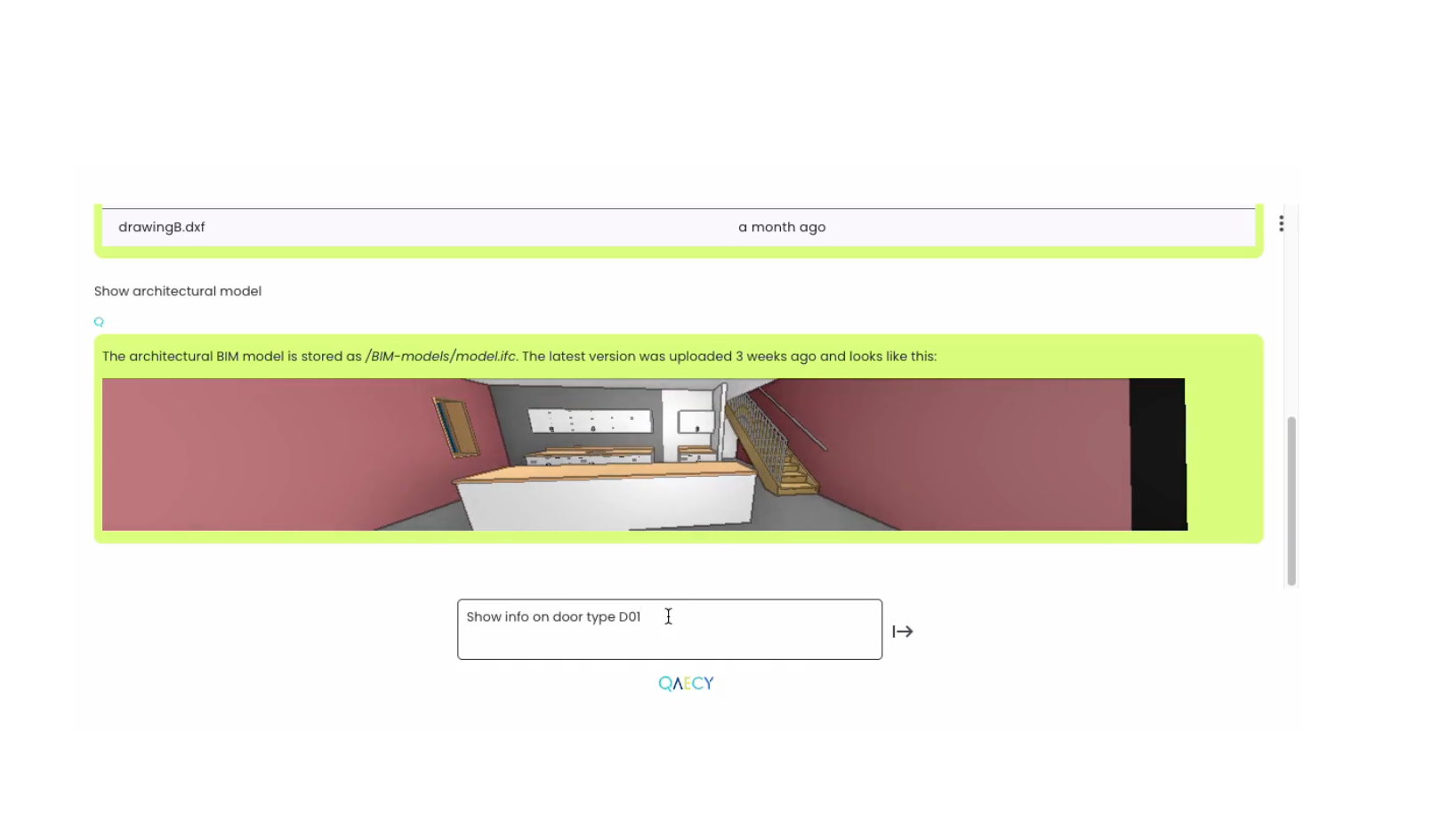
Instead of learning a query language or navigating five separate tools, you ask a plain-English question. The agent translates it, runs it, and hands back an answer with its sources.
MCP
The index is accessible from anywhere via MCP and a CLI
MCP — the Model Context Protocol — is an open standard that lets AI assistants connect directly to a live data source and query it in natural language. No custom integration code. No query language to learn.
Once connected, "ask the graph a question" becomes as ordinary as asking Claude anything else.
From documents to actionable knowledge
The whole arc of the course, on one line.
A single question, three stakeholders
"How many windows are on the northern façade, are any past their maintenance interval, and does the current lease allow us to replace them?"
cares about the façade composition
cares about the maintenance history
cares about the lease constraint
In a graph built on BOT and an Object Type Library, it's one traversal
Spatial topology, maintenance records and contract terms all resolve to the same canonical windows — queryable by anyone, answerable by an agent, with every claim traceable to its source document.
Is this the right fit?
Honest answers
A knowledge graph is not the right choice when…
- You have a single, well-defined data source already available in JSON or a database — a direct API is simpler and faster
- Your use case is a standard CRUD app with no need to reason across documents or entities
- You need results in days and the data is already clean, structured and complete
- You want to extract a few entities from a handful of documents — a simple LLM call or a lightweight script will get you there faster and cheaper
It is the right choice when…
- Knowledge is scattered across hundreds of files — drawings, models, contracts, reports — and you need to work across all of it
- You need to connect entities across different sources — the same asset appears in an IFC model, a P&ID, a contract and a maintenance log
- You want to build apps or run agents on top of the whole landscape of project knowledge, not just a slice of it
- Traceability matters — every answer must be backed by a source document
- Your data volumes, document diversity or cross-referencing needs are beyond what a hand-rolled solution can realistically handle
The signal: are you dealing with the full complexity of a large project?
If yes — that is exactly what this was designed for
Capstone Part A: "Draft your Object Type Library"
Always run this first. One sheet of paper per group.
In groups by role or building portfolio, 40 minutes.
- List 8–10 object types your organization deals with daily.
- Write 5–8 relationships between them, as plain sentences.
- Name one real question from your job that this structure could answer — and that you cannot answer today.
Two minutes per group to present.
Relationships, written as sentences
An Asset is located in a Space
A Work Order concerns an Asset
A Contract involves an Organization
A Document is about an Asset
If it reads like a sentence, it will work as an edge.
The blank grid
Eight to ten cards. Business language, not ontology language.
Closing case by cohort
Build the closing case around maintenance and compliance.
Build it around zoning, capacity and multi-building portfolio analysis.
Build it around lease obligations, asset lifecycle and portfolio-wide risk.
🖥️ Hands-on lab, Part B
"Ask it for real"
Requires a Cue sandbox project and the MCP connector
In groups, 45 minutes.
- Connect Claude to the sandbox Cue project you populated yesterday, using the Cue MCP connector.
- Ask two or three genuine natural-language questions about the Canonical Entities you created.
- For each answer, follow the source back to the row you loaded.
Questions worth asking
"Which rooms did I load that don't yet have an assigned category?"
"List every asset I mapped that's linked to Contract X"
"What do we know about Asset #88213, and from where?"
The point isn't the sophistication of the question.
Key takeaway
"This isn't a new system I have to convince everyone to adopt — it's the layer of shared meaning that finally lets everything we already have talk to each other, and to AI."
"And I just watched my own spreadsheet become part of that — no code, no IT ticket, no waiting."
Six days, six ideas
- 1 — Our data already behaves like a graph
- 2 — A fact is a claim, not a truth
- 3 — New questions don't need a new schema
- 4 — Ten simple ideas describe any building
- 5 — One shared vocabulary, not one system
- 6 — Everything we have can now talk to each other
What to do on Monday
- Take your Object Type Library sheet back with you
- Find the one authoritative list your organization already has — the asset register, the room programme, the member directory
- Pick the one question that spans two systems, and use it as the business case
Start with one question. Not with a platform.
Thank you — and good luck with your first Object Type Library.